Book of Changes guide: seven chapters, hidden ties, endings
A beginner's guide to Book of Changes: how the seven-chapter life novel runs from age 6 to 81, why relationships are the hidden stat that matters, what the coins do and don't decide, and how the six endings are chosen.
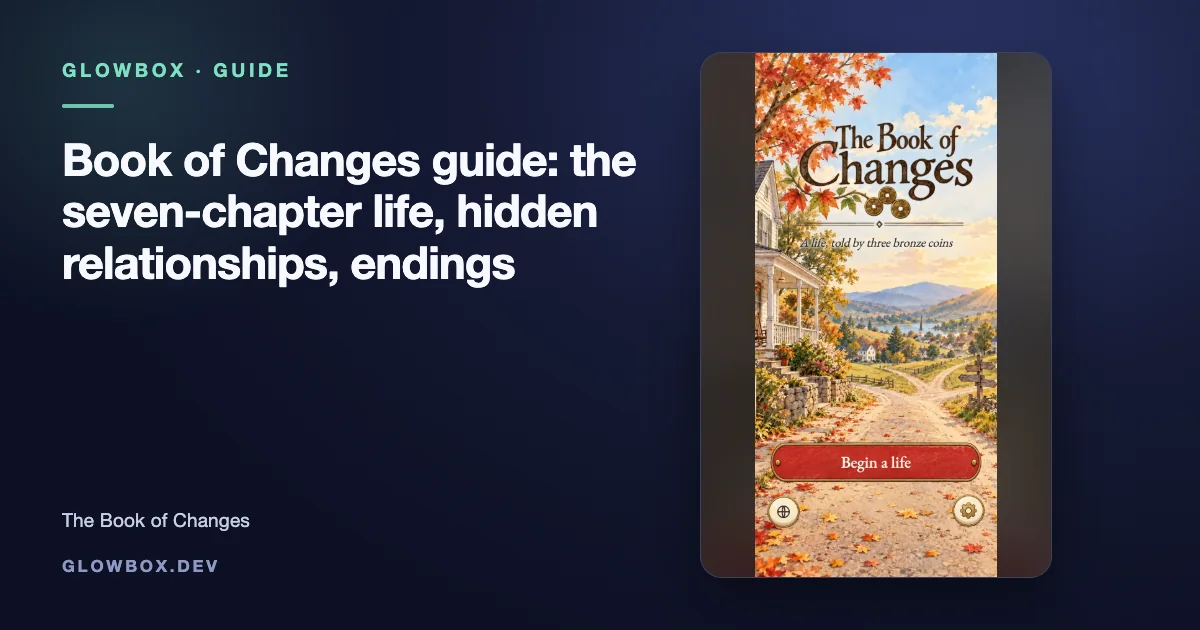
Book of Changes is not a coin-tossing puzzle. It is a life novel you play through: seven chapters, fifty-six scenes, 178 choices, and eleven recurring people, following one character from age six to age eighty-one. You make a decision at the end of most scenes, and everything else is story. If you have seen descriptions of this game as a series of crossroads and three bronze coins, that is an older version — this guide describes what is actually in the game now.
 The Book of ChangesLive an ordinary American life from childhood to eighty-one, choosing at every turn. The coins only ever hint.Play free in your browser →
Before the story starts
Tapping Begin a life takes you through three short screens:
- Your birthday, with an optional birth hour, or a Surprise me button that picks one. The birthday sets your five elements. It is used once to compute your chart and then thrown away — only the chart is kept, and the screen tells you the date never leaves the device.
- Your five elements, with a day master, a gift and a lesson, and a button to open your Book of Life.
- Who you are — a name, a skin tone, and whether you want to be Grandpa or Grandma. There is also a Rather not say — let the coins decide option that picks for you. Nothing here is required.
The Book of Life is six short chapters drawn from classical sources: your four pillars, your day master, your birth season, your animal and sound-element, your strongest element, and your birth hexagram. Each section quotes the original and gives James Legge's 1882 English alongside it. It is optional, but worth one pass — it is the only place in the game where the divination tradition is explained rather than used.
How the chapters work
The story runs in seven chapters by age: 6–12, 13–18, 19–29, 30–44, 45–64, 65 and on, and 81. The header shows only your name and your age, with a bar marking the seven chapter points. There is no score anywhere.
Reading is a matter of tapping. Each line appears one at a time; tapping the page advances to the next sentence, and there is a Show all button when you would rather skip the pacing. At the end of a scene you choose from three options — most scenes give you exactly three, some give four, and a couple drop to two because one option only appears if a relationship allows it. One scene has no choice at all and just ends with Go on.
Every step is saved. If you close the tab, the title screen shows Continue.
The hidden stat is relationship
Here is the mechanic that decides your life: behind the scenes the game tracks a relationship value for every person, plus a separate trust value, a set of flags, and a memory log. You never see a number.
The rule that matters is arithmetic:
- Each person has a scale running from -6 to +6.
- A loss counts double. If a choice costs two points of relationship, it takes four off.
- Positive gains are taken at face value.
So one cruel option undoes more ground than two kind ones build. If you want a single strategic rule from this guide, it is this: in a scene where one option is generous and the other is sharp, the sharp one is twice as expensive as it looks.
You do get three indirect readouts:
- After a choice, a small line tells you who will remember this. That is the memory log, and it decides whose photograph ends up in your album.
- At the end of each chapter, a card lists what you'll remember from that chapter and how they see you — Close, Steady, or Something unsaid, for each person.
- The My life panel, reached from the portraits in the header, lists everyone you have met and every memory, each tagged with who holds it.
Scenes can go missing
Some scenes only happen if a condition holds. In chapter three, if you and Maya are in a bad way, you do not get Maya's wedding — you get a different scene, in which you are not invited. Chapter four has a scene that only exists for certain people still in your life.
This is worth understanding before you assume you have seen everything. A missing scene is a result, not a bug. If a chapter felt thin, look at the previous chapter's card and ask who was already drifting.
The roads you did not take
Some choices record the option you passed up, and later a character will refer to the life you could have had. These appear as The roads not taken, listed by age. It is one of the better features in the game and a good argument for not rushing your first decision in a scene.
What the coins actually do
The I Ching appears six times, at ages 12, 17, 23, 43, 55 and 75. Each time you can toss three coins six times, or skip. When you do toss it, Juno's line is unambiguous: the coins give a hint, they don't choose for you. Go on.
Treat them as atmosphere. Every consequential decision in this game is one of the options at the end of a scene, and the coins do not touch it.
The endings
There are six endings, and they are not rolled at random. Each one has conditions attached to flags your choices set across the entire life — be at a parent's side in a particular winter, do not make excuses, say a real goodbye when someone leaves. The endings are checked in order, and the first one whose conditions you satisfy is the one you get.
The final screen keeps an Endings found n / 6 collection, and for every ending you have not lived it shows a short hint. That collection is the whole replay loop: live a life, read the hints, go again.
The final page also tells you whether you were the first person in the world to reach that ending, or what share of worldwide lives ended there. Live it again from chapter 1 restarts with the same name and appearance and a clean slate; Start a new life in the menu also changes who you are.
Tips that actually help
- Read the end-of-chapter cards. They are the only feedback in the game, and they tell you which relationship moved and which did not, per chapter rather than in total.
- Watch the "who will remember this" line. It is your memory log in real time. Choose with the person in mind, not with the outcome in mind.
- Do not spam the sharp option. Losses are doubled, and a relationship you push to -6 quietly removes scenes later.
- Sit with the first scene. Roads not taken are recorded, and characters bring them up later. Rushing the opening is the one thing you cannot undo.
- Use the six coin moments, but do not expect answers. They are atmosphere; the choice after each one is the real decision.
- Read the Book of Life once before you start. It takes a few minutes and explains the birth hexagram you will meet again later.
- Enter the birth hour if you know it. Without it, the hour pillar is simply left out, and the book says so rather than guessing.
A line in the game keeps this in proportion: the reading is for reflection and entertainment only, and nothing in it predicts your future, health, wealth or love life.
FAQ
Can I lose, fail or die in Book of Changes?
No. There is no score, no timer and no failure state. Nothing ends the story early. A relationship can go bad, but the consequence is that a scene changes or disappears, never a game over.
Is there a wrong choice?
There is no correct one and no undo. Once you pick, the story moves on. Each chapter ends with a replay button that restarts from chapter one with the same name and look, which is the intended way to try a different life.
How are the six endings decided?
Not by chance. Each ending has conditions tied to flags your choices set across the whole life, and they are checked in order — the first one you satisfy is the ending you get. The final screen shows a hint for every ending you have not lived yet.
Do I have to throw the coins?
There are six moments across the seven chapters, at ages 12, 17, 23, 43, 55 and 75, and you can skip every one of them. The game says it outright: the coins give a hint, they do not choose for you. Every decision is still yours to make.
Does it save my birthday?
No. Your birthday is used once to work out your chart, then discarded. Only the derived chart is kept. The screen that asks for it says the date never leaves the device, and that is literally true.
Which languages is the story written in?
The story itself exists in Chinese and English. The menus and buttons are translated into seven languages, so if you set the interface to Japanese, Korean, Russian, Spanish or French, you will be reading the English story.
Games in this guide
The Book of ChangesLive an ordinary American life from childhood to eighty-one, choosing at every turn. The coins only ever hint.Play free in your browser →Book of ChangesGuide
Comments
More guides
 GuidesLong Wind Inn price guide: eight goods, daily drift, profitThe price table looks like it says buy tea in Shenzhen and sell it in Almaty. It does not. Here is the actual price formula, the twelve city events, and the three ways a trade actually turns a profit.
 GuidesNight Siege guide: tower unlocks, the learning fox, obstaclesA plain guide to Night Siege: which towers unlock on which night, why the fox sends 70 percent of monsters down your weaker lane, how the three star objectives work, and what the free-text wish can and cannot do.
 GuidesLong Wind Inn guide: inns, border queue, cash bufferA plain guide to Long Wind Inn: how the game clock works, why the Khorgos border queue decides your route, what each way-abroad identity changes, and the only two ways a run can actually fail.