Long Wind Inn guide: inns, border queue, cash buffer
A plain guide to Long Wind Inn: how the game clock works, why the Khorgos border queue decides your route, what each way-abroad identity changes, and the only two ways a run can actually fail.
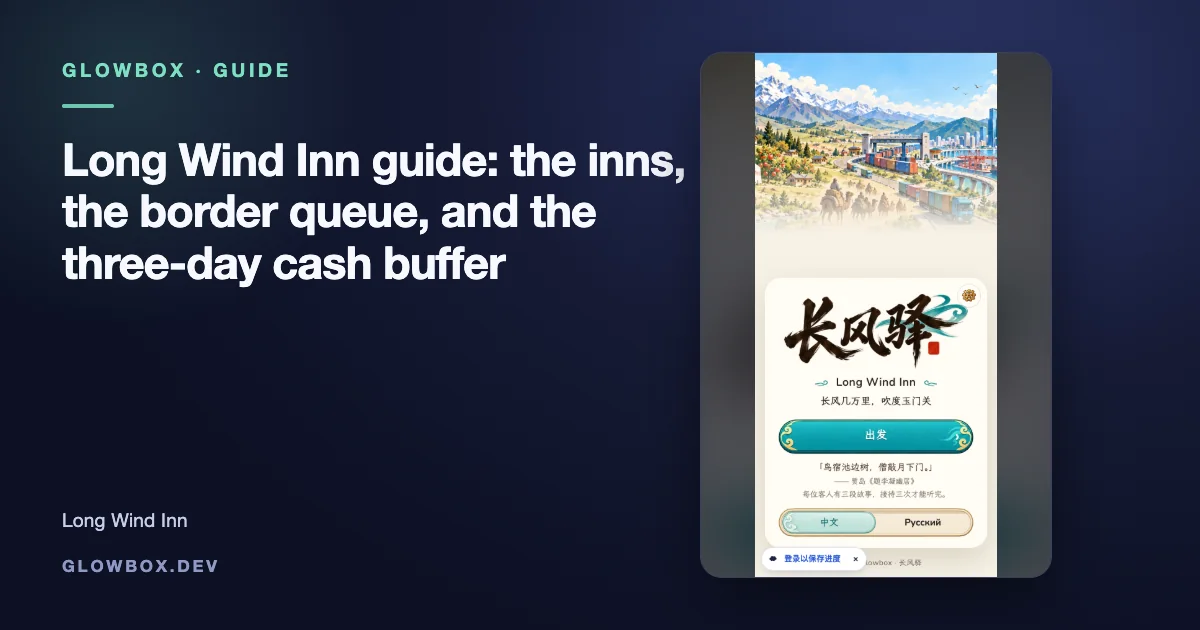
Long Wind Inn is a Silk Road business simulation with two halves that feed each other. You run an inn and a freight company. The freight side carries cargo between Shenzhen and Almaty, crossing at the Khorgos border. You pick a direction when you start — west from Shenzhen, or east from Almaty — and the route is mirrored, with its own opening chapter and ending.
Only three cities run an inn: Shenzhen, Khorgos and Almaty. Past the third chapter you can also open branch offices in seventeen more cities — Shanghai, Beijing, Guangzhou, Hangzhou, Chengdu and other Chinese cities in the east, and Astana, Shymkent, Tashkent, Samarkand and Kostanay further west. Offices unlock gradually (two by chapter five, no cap once you reach the second ledger), and each one opens up its own freight contracts. Other places still appear only in the writing. Visually it is deliberately calm: a pale daytime palette, warm sand backgrounds, a teal-green accent. This is a management game about margins and paperwork, not a horror or action game.
 Long Wind InnRun a Silk Road inn from Shenzhen to Almaty, host caravans, and trade local goods where they are rare.Play free in your browser →
How to play, step by step
- Choose your direction — west or east — and then choose how you go abroad. This is one of the biggest decisions in the game and you cannot switch out of it.
- Learn the layout. There are six tabs at the bottom and the whole game is tap-only. No dragging, anywhere. Tap Inn, Company, Orders, Market, Route and More.
- Collect earnings in the Inn tab. The inn pays passively but you must tap Collect, and it accumulates to a cap of 12 hours — tap it regularly or you waste income.
- Take orders from the Market, pick a shipping method, and watch the shipment move through its nodes.
- Watch the border. Every road shipment queues at Khorgos, and how long depends on that day's congestion.
- Deliver, get paid, reinvest in departments and fleet.
Learn the game clock first — it explains everything
One game hour is 5 seconds of real time. One game day is roughly two real minutes. Every duration in the game is measured in game hours, so before you decide whether to wait for something, do the arithmetic:
- 12 game hours of inn earnings = about 1 minute
- A 36-hour border queue = about 3 minutes
- A 120-hour jammed border queue = about 10 minutes
- 240 game hours = about 20 minutes
There are speed tickets, one per day, up to five at a time; using one halves the remaining time of a shipment. Chapter 1 shipments also run at a beginner-friendly pace automatically, and that help ends after chapter 2.
Once you are counting in hours rather than minutes, every deadline in the game becomes something you can actually plan around.
The border is the real opponent
Khorgos is congested differently every day, and it is worse in winter (December through February). There are three states, and they map to very different queues:
| Khorgos today | Queue (game hours) | Roughly |
|---|---|---|
| Clear | 0 | no wait |
| Busy | 36 | about 3 minutes |
| Jammed | 120 | about 10 minutes |
The queue only applies to road freight — a TIR direct run counts half the queue. Each level of your Operations department cuts the queue by 10 percent, which is the cleanest way to reduce it permanently. You can also buy a priority slot, one per day, which skips the queue entirely for that load, and the price rises with how bad the congestion is.
Air freight bypasses the border entirely. This is the key insight: air is the most expensive method and it does not save you money, it buys you time. When a deadline is tight or the border is jammed, paying for air is often correct.
The four shipping methods
- Train — cheapest and slowest. Not everything can go by train: oversize and live cargo are excluded.
- Transload — changing vehicle at the border. Middle price.
- TIR direct — faster, needs a TIR licence and your own trucks. Half the queue.
- Air — most expensive, fastest, skips the border. Charges by weight, so it does not suit full loads.
There is a set of real logistics nodes a shipment passes through — Export declaration, Border, Flight, Customs transit, Import clearance, Warehouse, Delivery — and each has its own way of going wrong: a missing form, a random inspection, a full flight, a seal question, extra documents, no free dock space, a customer who moved. Delays are shown in hours on the shipment card, and you can pay to rush one.
Cargo also has requirements. Fragile, oversize, battery, liquid, powder and grain items are all tagged, and some tags rule out specific methods — lithium batteries cannot fly, for instance.
Three income lines, no star rating
Money comes from three places:
- Passive inn income — accrues over time, capped at 12 hours, must be collected by hand.
- Guests — receiving a paying guest pays immediately.
- Consignment rewards — delivering an order pays out.
There is no star system in this game. If you see stars, they are decorative icons, not a rating you can improve. The numbers that matter are guests received, deals done and profit.
There are 21 guests, each with three story beats — 63 passages — and 9 main chapters across two ledgers. Along the way you can name your company, get a written draft written for you, read a chronicler's summary, and run a weekly meeting. All four have local fallbacks, so they never block progress. The charter writer is the one that may not always appear, depending on the build.
The identity you pick changes the whole game
Your starting position is set once, at the beginning:
| Identity | Coins | Cost multiplier | Staff |
|---|---|---|---|
| Sole trader | 400 | 0.8 | none — you do everything |
| Small business | 600 | 0.9 | Sales, Operations |
| E-commerce | 800 | 1.0 | Customer care |
| Private company | 1,500 | 1.15 | Sales, Operations |
| Listed company | 5,000 | 1.25 | six departments |
| State enterprise | 8,000 | 1.3 | eight staff |
Two consequences worth reading twice: a sole trader must staff everything alone but every coin stretches further, and a small-business loan repays at 1.4 times, the worst borrowing rate in the game.
Listed company adds a quarterly system: every 7 days is a quarter. Miss the revenue target and the share price drops 15 percent; two quarters in a row and the board replaces one of your managers. State enterprise adds approval friction: every investment is submitted and only takes effect the next day, and inspections are 1.3 times more likely. Unless you want the quarterly or approval pressure, starting smaller is the smoother route.
Departments, and the weekly dice roll
There are seven departments — Sales, Customer care, Operations, Finance, Legal, HR, Customs — each with five levels, and each does something concrete: Operations shortens queues and speeds up trips, Finance lowers daily costs and softens currency shocks, Legal unlocks licences and reduces inspections, Customs makes paperwork pass first time.
Once a week, each department rolls for whether something goes wrong, weighted by its level. This is the main source of mid-game friction, and it is why department levels matter more than the number of trucks you own.
There are only two ways to fail
1. Negative balance for three days in a row. You get a cash crisis and pick from selling a truck at half price, borrowing, issuing shares or asking for budget — and a small-business loan repays at 1.4 times. The useful part: this needs three consecutive days, so you have two full days of warning. Watch the balance line on your dashboard.
2. One specific chapter's wheat deadline. In the third ledger's first chapter you must deliver three wheat return shipments within 240 game hours — about 20 real minutes at normal speed. Miss it and that chapter fails.
That is the complete list. Late shipments cost money and reputation; spoiled cargo and walked-out clients hurt; but none of those end a run.
FAQ
What is Long Wind Inn actually about?
It is a Silk Road business simulation with a freight side. You run an inn and a freight company together, running cargo between Shenzhen and Almaty through Khorgos on the China–Kazakhstan border. You choose a direction at the start: west from Shenzhen, or east from Almaty, and each direction has its own opening and its own ending. Only three cities run an inn — Shenzhen, Khorgos and Almaty — but past the third chapter you can also open branch offices in seventeen more cities. The picture is deliberately light and warm: a pale daytime palette with sand tones and a teal-green accent.
How do I control anything? Is there dragging?
No. Everything is tap-only, there is no drag anywhere in the game. Six tabs sit along the bottom: Inn, Company, Orders, Market, Route and More. That means it works on a phone screen without any fiddly gestures.
How fast does time pass?
One game hour is 5 seconds of real time, so one game day is about two real minutes. Everything in the game is denominated in game hours — border queues, flight times, deadlines, spoilage — so the single most useful habit is to convert to hours before you decide to wait. You also get one speed ticket a day, up to five, and using one halves the remaining time of a shipment.
Where does money come from?
Three lines. Your inn earns passively but you have to tap Collect and it caps at 12 hours of earnings. Serving guests pays immediately when you receive them. And delivering a consignment pays a reward. There is no star rating in this game: the stars you see are decorative icons, not a score. The progress you actually care about is guests, deals, and profit.
Why does the Khorgos queue matter so much?
Because Khorgos is congested differently every day, and worse in winter (December to February). There are three states: clear, busy and jammed, and the queue is 0, 36 or 120 game hours. The queue applies to road shipments only — a direct TIR run counts half. An Operations department level cuts the queue by 10 percent per level. There is also a paid priority slot, one per day, that skips the queue entirely. Air freight skips the border but costs the most.
What are the four ways to move cargo, and which should I use?
Train is the cheapest and slowest. Transload (changing vehicle at the border) sits above it. TIR direct is faster but needs a TIR licence and your own trucks. Air is the most expensive and fastest. The order of price is always air above TIR above transload above train. Choose by deadline, not by cost: air buys you time, it does not save you money.
What does my choice of way-abroad identity change?
A great deal, and it is not reversible. A sole trader starts with 400 coins and pays 0.8 times costs but has no staff at all. A small business has 600 and 0.9 costs but has a loan that repays at 1.4 times. A private company has 1,500 and 1.15 costs. A listed company has 5,000, six staff and a quarter every 7 days where you miss target the share price drops 15 percent, and two quarters in a row makes the board replace one of your managers. A state-linked enterprise has 8,000 coins, 1.3 costs, eight staff, every investment needs approval and only takes effect the next day, and inspections are 1.3 times more likely. Start small unless you specifically want the quarterly pressure.
Can I lose this game?
There are exactly two hard failures. First, if your balance is negative for three days in a row you get a cash crisis and must choose from selling a truck, borrowing, issuing shares or asking for budget — and a small-business loan repays at 1.4 times. That means you have two full days of warning. Second, one specific chapter requires you to deliver three wheat return shipments within 240 game hours, which is 20 real minutes at normal speed, or you fail that chapter. Nothing else in the game is a game over.
Does it need an internet connection?
Most of it does not. Saving is automatic in your browser, there is no manual save to forget, and you can export a save code from Settings to move between devices. Several written moments have local fallbacks, so a missing connection does not block progress.
Games in this guide
Long Wind InnRun a Silk Road inn from Shenzhen to Almaty, host caravans, and trade local goods where they are rare.Play free in your browser →Long Wind InnGuide
Comments
More guides
 GuidesLong Wind Inn price guide: eight goods, daily drift, profitThe price table looks like it says buy tea in Shenzhen and sell it in Almaty. It does not. Here is the actual price formula, the twelve city events, and the three ways a trade actually turns a profit.
 GuidesNight Siege guide: tower unlocks, the learning fox, obstaclesA plain guide to Night Siege: which towers unlock on which night, why the fox sends 70 percent of monsters down your weaker lane, how the three star objectives work, and what the free-text wish can and cannot do.
 GuidesDaily Hexagram guide: reading a cast, the 64 signs, and the pagesA beginner's guide to Daily Hexagram: how three coins become a sign, which text the game reads, how the 7-page scrolls and the daily question work, and why the album fills at the rate it does.