Night Siege guide: tower unlocks, the learning fox, obstacles
A plain guide to Night Siege: which towers unlock on which night, why the fox sends 70 percent of monsters down your weaker lane, how the three star objectives work, and what the free-text wish can and cannot do.
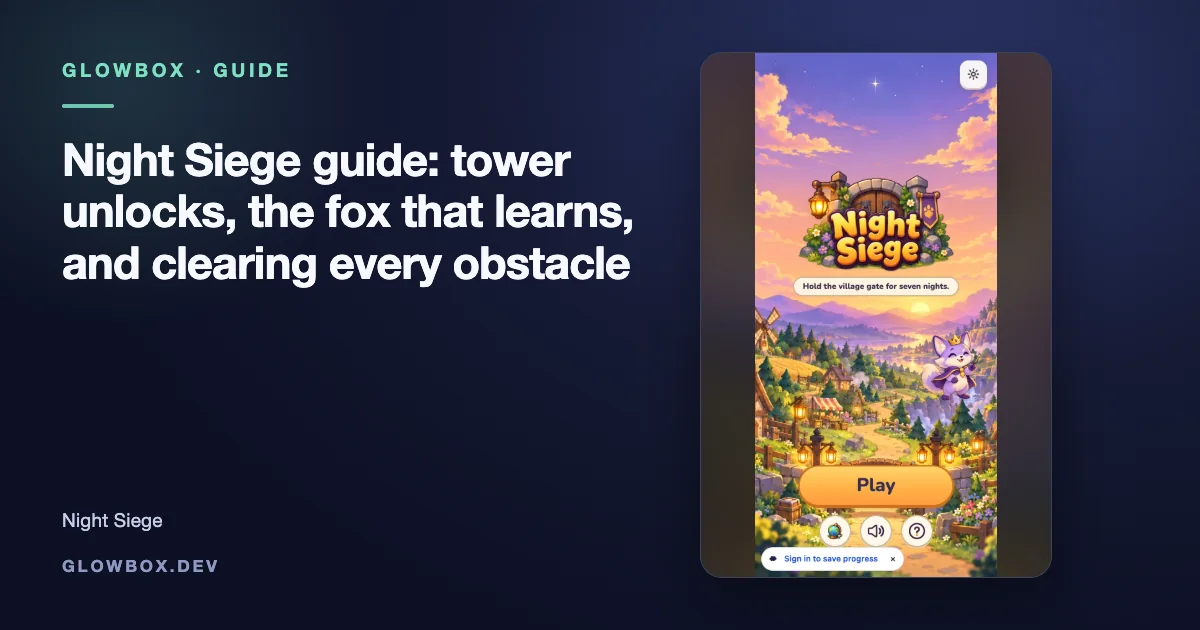
Night Siege is a tower defence game about holding a small town for a run of consecutive nights. Toy-named monsters walk up the road toward your gate. You build towers on stone circles, they shoot things apart, and every monster that reaches the gate puts out one of your paper lanterns. Lose all ten lanterns in a single night and the run ends.
The name is about the seven nights of the defence, not the time of day. The palette is warm evening colour — a peach sky fading to cream — and nothing in it is dark or frightening. The Lantern Ghost in particular is a shy paper-lantern spirit you have to spot, not a horror enemy. You start with 10 lanterns; a monster that gets through blows one out. Hold the night and you reach the next dawn, where the game offers you cards.
 Night SiegeBuild towers along a path to hold a village gate for seven nights, against a fox who studies how you build.Play free in your browser →
How to play, step by step
- Pick a town on the map. Meadow Villages come first (towns 1–10, three nights each), then Autumn Woods (11–20, five nights) and Snowy Heights (21–30, seven nights).
- In the preparation phase, tap a stone circle on the map. A build strip opens at the bottom — tap a tower badge, or press 1 to 5.
- Tap a tower you already own to upgrade it or sell it. Selling returns 60 percent of what you put in.
- Press Space to start the night, or Enter. Space also pauses. F switches battle speed and Esc opens the menu.
- During the fight you can tap a monster to focus your towers on it, and you can call the next wave early for a gold bonus — the reward scales with how early you call it.
- At dawn, take one of three blessing cards, or reroll, or skip.
The map is a 7 by 10 grid with two lanes. A normal night is five waves; a seven-night town's final night has six, and it ends with the Banner Golem boss, which has 5 lives.
The thing most beginners get wrong: towers unlock by night
You do not have all five towers from the start, and this is the single biggest reason an early run feels thin.
- Night 1: arrow tower and fire brazier only
- Night 2: militia house and frost bell unlock
- Night 3: lantern post unlocks
Each tower has three levels, so check the build menu each dawn instead of assuming night 1 is all you get. What each one is good for:
- Arrow tower — hits ground and air, cheap, your backbone.
- Fire brazier — splash plus burn. Good against packed groups on its own. The extra effect where burnt monsters pop and hurt the monsters next to them comes from the rare Popcorn card you can pick at dawn, not from the tower itself.
- Militia house — throws rocks that ignore armour, and is the best tower by a wide margin against obstacles. That matters for one of your three stars.
- Frost bell — low damage, but it slows, making everything else hit longer.
- Lantern post — reveals Lantern Ghosts and buffs nearby towers' damage. Detection, not damage.
Stars come from three separate objectives
Every town awards one star per objective completed, up to three:
- Held — you survive the night.
- No lantern lost — you finish with all ten still burning.
- Cleared — every obstacle on the map is destroyed.
The third one is the trap. Obstacles do not attack you, so a run can feel finished while a stack of rocks is still sitting there, and that star is simply gone. Obstacles also block building spots and pay you gold when cleared, so clearing them helps twice. If you are going to chase three stars anywhere, this is where the missing star usually is.
Stars do two jobs: they gate the next town (you need to hold town N to open N+1), and they are currency. Stars you spend never come back, so if you are unsure, spend them on something you will use in every single night rather than a one-off.
The fox remembers, and that changes how you should build
This is the mechanic that makes Night Siege different from most tower defence games.
There is a fox, and it keeps a permanent record on your device across separate runs. Every time you beat it, it learns one new trick chosen specifically to counter how you defend — up to nine tricks, kept forever. It classifies your style from your tower mix, whether you hoard money, and whether you favour one lane, then picks a counter from a fixed table.
You can turn this around and do it back. A town layout compresses into a short share code, and a friend can run a full simulation of your town on their own phone — no server involved — on a fixed budget of three waves with no Workshop bonuses, so it is a fair fight.
Two things follow:
- Do not over-fit. A defence built from one tower type is trivially classified and trivially countered. Mixed defences keep working longer.
- Watch your lane balance. The fox reads your layout each night and sends 70 percent of a weak-lane wave down whichever side you defend less well, the rest down the other. Stacking one road is exactly the shape it looks for.
Everything the fox does is decided by code — trick selection, numbers, spawn templates, lanes. The AI only writes the line announcing what it learned. Same seed, same replay, which is what makes a shared town a fair test.
Free-text wishes: what they actually do
Once a dawn, a fourth slot offers a wish you type yourself. It sounds like the place to ask for something broken. It is not.
Your sentence is sorted into one of twelve fixed effect types, given a greed level from 1 to 5, and given a price, and the code computes the actual numbers. Asking for something that ignores the rules produces the weakest card, not a broken one. The rule that catches people: greed level 3 or higher always costs something — a life, a price penalty or a speed penalty. Want a clean upgrade? Keep your phrasing modest.
You can reroll or skip the three offered cards. Before the typing slot unlocks the game asks whether you are 13 or older; choosing "Not yet" keeps the three cards. That gate is part of the platform build, so it may not appear everywhere.
Where beginners actually lose
- Over-building one lane, because of the 70 percent weak-lane rule. Keep both lanes roughly even.
- Forgetting the obstacle objective. It is the easiest star to miss and the easiest to go back for.
- Ignoring armour. Shield Beetle shrugs off arrow damage by design; the militia house exists for this. Do not spend militia towers on everything.
- Leaving the air route uncovered. Bat Kites fly and only some towers reach them.
- Being surprised by the curve. Monster health scales steeply with the night number and each night's wave budget grows on a curve, so the gap between nights widens as you go.
Advanced habits
- The sell rate is 60 percent. Repositioning a bad night-2 tower is a real option.
- Focus fire beats raw DPS. Tapping a monster mid-night concentrates your whole defence on one target, which is usually worth more than a better tower when a boss or an armoured unit is on screen.
- Early wave calls are free gold, and pay more the earlier you call them.
- Lantern posts are detection, not damage. Pair one with nearby towers for the damage buff and use it to find ghosts.
- Take the frost bell seriously — almost no damage alone, but every slowed second is a second your other towers get.
- Read what the fox has learned. If it counters your fire, shift your defence rather than buying more fire.
FAQ
Is Night Siege a dark or scary game?
No. Despite the name, Night Siege is bright and warm. The name refers to the seven-night defence of the town, not to the time of day. The palette runs from a peach sky to cream, and the monsters are named after toys: Fluff Ball, Scarf Hare, Shield Beetle, Bat Kite, Mud Pudding, Lantern Ghost, Stone Troll and Banner Golem. The Lantern Ghost is a shy paper-lantern spirit, and the lantern tower does not hurt it, it reveals it. Nothing in the game has blood, skulls or gore.
How do I build a tower?
During the preparation phase, tap an empty stone circle on the map, then tap a tower badge at the bottom, or press the number keys 1 to 5. Tap a tower you have already built to upgrade it or sell it back at 60 percent. Press Space to start and pause, Enter to start, F to change battle speed, and Esc for the menu.
Which towers do I have on night 1?
Two. The arrow tower and the fire brazier are available from night 1. The militia house and the frost bell unlock on night 2, and the lantern post unlocks on night 3. Every tower has three upgrade levels, so check the build menu each dawn instead of assuming night 1 is all you get.
How do I earn three stars?
Each town has three separate objectives and each one you complete gives you one star: hold the night without losing, keep every lantern lit for the whole night, and clear every obstacle on the map. The lantern objective means you finish all your nights with all ten lanterns still burning. Clearing obstacles is the one players forget, because nothing attacks you if you skip it.
What does the fox do that no other tower defence does?
The fox remembers you across runs, and it is saved on your device permanently. Every time you beat it, it learns one new trick chosen specifically to counter the style of defence you use, up to nine tricks. It also reads your tower layout each night and picks attack templates and routes based on what you have built. Nothing about this is decided by a language model: the code picks the trick and applies the numbers, and the AI only writes the line about it.
Why do most monsters come down one side?
Because the fox sends 70 percent of a weak-lane wave down whichever side you defend less well, and the remaining 30 percent down the other. Defending one lane heavily is exactly what it looks for. Keep both lanes reasonably even instead of stacking everything on one road.
Can I type in a wish and get an overpowered card?
No. Your typed wish is sorted into one of twelve fixed effect types, a greed level from 1 to 5, and a price, and the code then computes the numbers. Asking for something ignores the rules does not produce a broken card, it produces the weakest one. Any greed level of 3 or higher always costs something, and you can reroll or skip the three offered cards instead.
Does the AI change the game or make it unfair?
No. The code decides which night template spawns, which lane each monster uses, all health and damage numbers, and the trick the fox learns. The AI only sorts your wish into a category and writes flavour text, and every AI moment has a pre-written fallback line. The same seed replays exactly, which is what makes a shared town fair.
Does it need an internet connection?
The game itself plays offline. The only thing that needs the platform is the free-text wish slot, and even that has a fallback. Progress saves automatically to your browser and resumes mid-night by replaying your action log, so closing the tab does not lose the night.
Games in this guide
Night SiegeBuild towers along a path to hold a village gate for seven nights, against a fox who studies how you build.Play free in your browser →Night SiegeGuide
Comments
More guides
 GuidesLong Wind Inn price guide: eight goods, daily drift, profitThe price table looks like it says buy tea in Shenzhen and sell it in Almaty. It does not. Here is the actual price formula, the twelve city events, and the three ways a trade actually turns a profit.
 GuidesLong Wind Inn guide: inns, border queue, cash bufferA plain guide to Long Wind Inn: how the game clock works, why the Khorgos border queue decides your route, what each way-abroad identity changes, and the only two ways a run can actually fail.
 GuidesDaily Hexagram guide: reading a cast, the 64 signs, and the pagesA beginner's guide to Daily Hexagram: how three coins become a sign, which text the game reads, how the 7-page scrolls and the daily question work, and why the album fills at the rate it does.